
Air conditioning licensing rules in WA: what a contractor must legally hold
By Clara Abbott · Updated 2026-07-18
This guide is general information, not legal advice. Licensing rules can change, and you should confirm current requirements with the relevant WA regulator before relying on anything here.
Licensing rarely comes up as the exciting part of hiring an air conditioning contractor, but it’s the part that actually protects you if something goes wrong. Two separate licences matter for most jobs, and knowing what each one covers makes it much easier to ask the right question before you sign off on a quote.
The two licences that matter
Refrigerant handling (ARCtick). Any work that involves handling refrigerant gas, installing a new system, regassing an existing one, or decommissioning an old unit, legally requires the technician to hold a current licence issued under the national ARCtick scheme, run by the Australian Refrigeration Council. This applies across Australia, not just WA, and it exists because refrigerant gas carries real safety and environmental risks if handled incorrectly.
Electrical contracting. Wiring a new air conditioning unit into your home’s electrical supply, or working with an existing circuit, is electrical work. In WA, that requires a licensed electrical contractor, regulated through Building and Energy, part of the WA Department of Energy, Mines, Industry Regulation and Safety. Some air conditioning businesses hold both licences under one roof; others are refrigeration specialists who bring in a licensed electrician for the wiring component.
| Licence | Covers | Regulator |
|---|---|---|
| ARCtick (refrigerant handling) | Installing, regassing, decommissioning systems with refrigerant | Australian Refrigeration Council |
| Electrical contractor’s licence | Wiring the unit to your home’s electrical supply | Building and Energy WA |
Why this actually matters to you
Beyond the legal requirement, licensing has practical consequences for a homeowner. Manufacturers generally require licensed installation to honour a warranty on the unit itself, so unlicensed work can quietly void cover you’d otherwise have. Home insurance can be affected too if work carried out on your property wasn’t done to a legal standard. And from a straightforward safety angle, refrigerant and electrical faults aren’t the kind of thing worth cutting corners on to save a bit of money upfront.
How to check before you hire
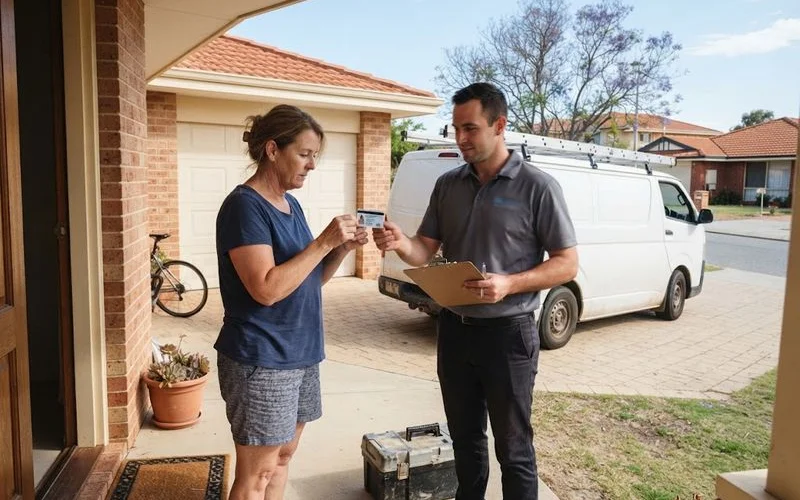
Ask for a licence number directly, most legitimate contractors will provide this without hesitation, since it’s a routine part of quoting this kind of work. From there:
- Refrigerant handling licences can be verified through the Australian Refrigeration Council’s public register.
- Electrical contractor licences can be checked through Building and Energy WA’s licensing search.
It only takes a couple of minutes, and it’s a much more reliable signal than a business simply claiming to be “licensed and insured” on their website without giving you a number to check.
What to do if a contractor can’t confirm licensing
Treat it as a hard stop, not a minor gap. A contractor who’s cagey about licence details, or claims it’s “not needed” for your particular job, is either mistaken about the law or hoping you won’t ask twice. Either way, it’s not worth the risk to your home, your warranty, or your safety.
Insurance and business registration
Beyond the two core licences, it’s reasonable to ask whether a contractor carries public liability insurance, which covers accidental damage to your property during the job. Most established businesses carry this as a matter of course, and a contractor who can’t answer clearly is worth a second thought. You can also check a business’s registration through the Australian Business Register if you want an extra layer of confirmation that you’re dealing with a legitimate, ongoing operation rather than an unregistered one-off arrangement.
If you’re weighing up approval and compliance for a new outdoor unit specifically, our guide on noise rules, council approval and body corporate consent for outdoor units in Perth covers what to check beyond just licensing.
A word on subcontracted work
Some larger installation and servicing companies subcontract parts of a job, particularly the electrical component, to a separate licensed electrician rather than employing one directly. That’s a completely normal arrangement and doesn’t need to raise concern on its own, but it’s worth asking who’s actually doing the electrical work and confirming that person’s licence too, rather than assuming the head contractor’s licence automatically covers every trade involved in the job.
For how we factor licensing and other trust signals into our contractor rankings, see our methodology page. Head to the home page for other guides on choosing and working with a Perth air conditioning contractor.
FAQ
- What is an ARCtick licence?
- It's the licence issued under the national scheme run by the Australian Refrigeration Council that authorises a technician to legally handle refrigerant gas, covering installation, servicing and decommissioning of air conditioning and refrigeration equipment.
- Do I need a separate electrical licence check as well?
- Yes. Wiring an air conditioning unit to your home's electrical supply is electrical work, which in WA requires a licensed electrical contractor. Some businesses hold both refrigerant and electrical licences; others coordinate with a licensed electrician for that part of the job.
- How can I verify a licence is current before hiring?
- Ask the contractor for their licence number and check it through the relevant regulator: refrigerant handling licences can be verified through the Australian Refrigeration Council, and electrical contractor licences through Building and Energy WA.
- What happens if unlicensed work is done on my home?
- Aside from the safety risk, unlicensed electrical or refrigerant work can affect your home insurance and any warranty on the unit, since manufacturers generally require licensed installation to honour their terms.